

If you spend more than a day or two in Marseille, you’ll start to notice a striking contrast.
The city itself is lively, rough around the edges, full of noise and energy. And yet, just 30 minutes away, there’s a landscape that seems almost unwilling to compromise with visitors.
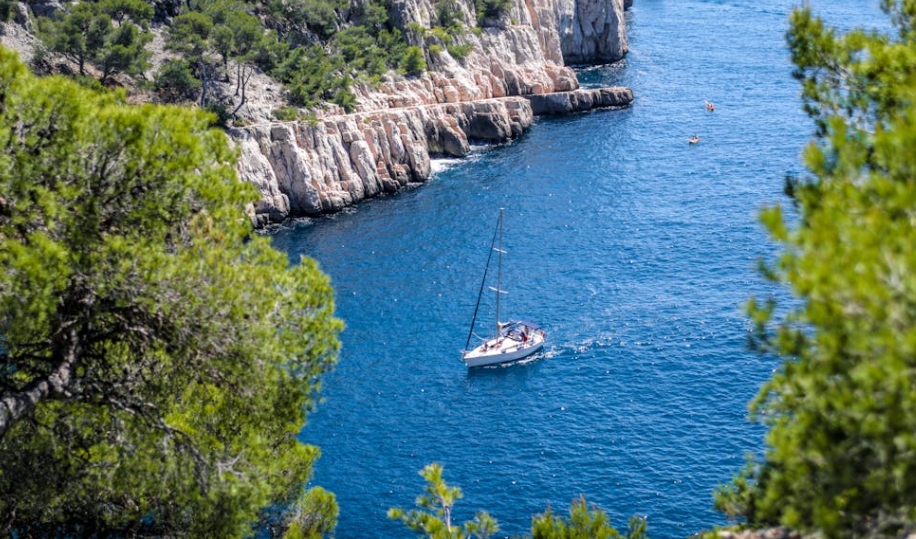
Leave the port early in the morning, and city buildings slowly give way to pale limestone cliffs. When you finally reach the edge of a calanque and look down at the narrow stretch of deep blue water below, most people instinctively fall silent.
This is Calanques National Park.
Not a Classic Fjord — but Sharper
Strictly speaking, the Calanques are not “true fjords.”
They are better described as deep limestone inlets carved over millions of years by erosion, rainfall, and the slow advance of the sea.
The result is a landscape with a very distinct character:
- White limestone cliffs dropping almost vertically into the sea
- Pine forests clinging improbably to rock faces
- Water shifting from pale turquoise to deep blue in layered gradients
You’re not walking along the sea here — you’re often standing directly above it.
Because this ecosystem is both rare and fragile, France designated the area as its 10th national park in 2012. It is also one of the few national parks in Europe that simultaneously protects urban-edge land, forests, cliffs, and marine environments.
Why the Calanques Are Worth a Dedicated Visit
Let’s be honest:
If you’re only looking for easy photo stops, the Calanques are not the most effortless option.
But they offer a few advantages that are hard to match.
1️⃣ The scenery comes quickly — no long suffering required
Many of the most iconic views can be reached within 2 to 4 hours of hiking.
You don’t need multi-day treks or advanced mountaineering skills.
One turn in the trail, and suddenly the cliffs open up, revealing the sea below.
Those “now I get it” moments happen often here.
2️⃣ More rules, but a cleaner experience
From April through the end of September, private vehicles are banned from the park’s core areas, except for local residents.
It sounds inconvenient — and sometimes it is.
But the result is:
No traffic noise
No overdevelopment
No viewpoints designed around parking lots
Most of what you see has to be earned on foot.
3️⃣ Outdoor activities aren’t optional extras — they’re the point
The Calanques aren’t a place where hiking is something you “can also do.”
They exist because of outdoor movement:
- Hiking: well-marked trails with extremely high scenic payoff
- Rock climbing: one of Europe’s top coastal climbing destinations
- Snorkeling & diving: remarkably clear water
- Kayaking: seeing the cliffs from sea level is a completely different experience
Who This Park Is (and Isn’t) For
This is something many guides avoid saying clearly — but it matters, especially for trip planning.
✅ The Calanques are ideal for:
- First-time visitors to France who want nature beyond cities
- Travelers who enjoy hiking but prefer moderate distances
- People who accept rules and trade a bit of comfort for real scenery
- Those seeking quiet, dramatic Mediterranean landscapes
❌ They may not be ideal if you:
- Travel with strollers or have limited mobility
- Want drive-up viewpoints with minimal walking
- Plan to hike casually at midday in peak summer
- Have only a few hours available
In short:
The Calanques suit travelers willing to adapt to the landscape — not those expecting the landscape to adapt to them.
Practical Tips: How to Avoid Mistakes on Your First Visit
The area
The park stretches roughly 20 km from the outskirts of Marseille to La Ciotat.
You don’t need to see everything — choosing one area is usually better.
Best way to explore: hiking
For a first visit, relying only on boat tours or peripheral viewpoints means missing the heart of the park.
Activities and suitability overview
| Activity | Best for | Advantages | Things to know |
|---|---|---|---|
| Hiking (recommended) | First-time visitors | Highest scenic density | Limestone can be slippery |
| Kayaking | Sea-level views | Access to hidden coves | Weather-dependent, physical |
| Rock climbing | Experienced climbers | World-class routes | Not beginner-friendly |
| Boat tours | Short stays | Easy, time-saving | You see it, but don’t enter it |
| Midday summer hiking | ❌ | — | Heat, sun, higher risk |
Best time to visit
May–June & September: best balance overall
July–August: stunning water, but hot, crowded, and more restrictions
Winter: good for hiking, not for swimming
In summer, always check fire-risk access restrictions, as trails can close with little notice.
A Reality Check Worth Knowing in Advance
The Calanques are not designed to be accommodating.
There are no water stations, no extra paths “just in case,” and no guarantees of comfort.
You’re responsible for your timing, your water, and your judgment.
But if you accept that —
what you get in return is one of the cleanest and most powerful natural experiences in southern France.
Why So Many People Come Back
Because this isn’t a place you simply “tick off.”
It’s a place where you remember:
- which cliff you sat on
- where the wind came from
- what color the sea was below your feet
In the Calanques, the landscape isn’t a backdrop.
It’s something you reach, step by step.