





Let me say this upfront.
There’s nothing wrong with the Eiffel Tower itself.
What usually disappoints people is going without thinking it through first.
Typical mistakes look like this:
Visiting at noon under harsh sunlight
Forcing yourself up the tower when you’re already exhausted
Buying a top-floor ticket on a foggy or windy day
This guide isn’t here to “introduce” the Eiffel Tower.
It’s here to help you decide one thing:
Is it worth spending part of your limited Paris time on it—and if yes, how should you do it?
⏱️ 30-Second Quick Check: Should You Go Up the Eiffel Tower?
If you just want a fast answer, start here.
The most honest conclusions
- First time in Paris + clear weather → Going up is usually worth it
- Tight schedule or strong fear of heights → Staying on the ground is perfectly fine
- Want to see the city layout, not “check a box” → Go up to the second floor only
- Fog, strong wind, or rain → Skip it—the experience drops fast
Your options at a glance
| Option | Best For | What It’s Like | Time Needed | Recommendation |
|---|---|---|---|---|
| Ground level & Champ de Mars | Short on time, avoiding queues | Most relaxed atmosphere | 30–60 min | ⭐⭐⭐⭐☆ |
| Up to the second floor | Most first-time visitors | Best balance of view & comfort | 1.5–2 hrs | ⭐⭐⭐⭐⭐ |
| Top floor | “I need to go all the way” travelers | Very high, weather-dependent | 2–3 hrs | ⭐⭐⭐☆☆ |
If you already see your answer here, you don’t need to read further.
Should You Go Up? Here’s the Non-Official Truth
I don’t fully agree with the idea that
“If you don’t go up the Eiffel Tower, you haven’t really been to Paris.”
But I also won’t deny this:
for a first visit, on a clear day, going up once can genuinely be worth it.
The difference comes down to intent.
Are you there to tick a landmark off your list,
or are you trying to understand what Paris actually looks like?
Second Floor vs Top Floor: The Difference Is Bigger Than You Think
The second floor: my strongest recommendation
If you have to choose only one level, I’d pick the second floor without hesitation.
From here, you can clearly see:
How the Seine curves through the city
The density and rhythm of Parisian neighborhoods
That Paris isn’t just “romantic postcards,” but a very real, lived-in city
One very practical tip:
If your legs allow it, take the stairs up to the second floor.
In many cases, it’s faster than waiting for elevators—and feels far less rushed.
The top floor: not bad, just conditional
The issue with the top floor isn’t the height—it’s reliability.
- Even light fog can wipe out distant views
- Strong wind makes it uncomfortable to stay long
- Waiting times are noticeably longer
If reaching the very top matters deeply to you, go for it.
If you’re there mainly for the view, the second floor is the better choice.
Timing Matters More Than You Expect
This often matters even more than whether you go up.
The best times to visit
Before 10 a.m. or after 8 p.m.
Morning: fewer crowds, easier photos
Evening: the moment the lights come on truly feels different
Seasonal reality check
Spring & fall: the safest bet—comfortable weather, manageable crowds
Winter (excluding Christmas): quiet, but cold and windy
Summer daytime: hot, crowded, and tiring—not ideal
One simple rule:
Bad timing can ruin even the best landmark.
Queues and Tickets: Let’s Be Real
If you show up without a ticket during peak season or on weekends,
waiting 1–2 hours is completely normal.
My advice is very straightforward:
Book tickets online in advance
Choose stairs when possible
Avoid noon to 4 p.m. if you can
This isn’t about saving money.
It’s about saving your energy for Paris itself.
Who Should Honestly Skip Going Up?
I’m intentionally clear here.
You can safely skip going up if:
You have a strong fear of heights
Your itinerary is already packed tight
You only want a quick classic photo
The weather is windy, rainy, or very foggy
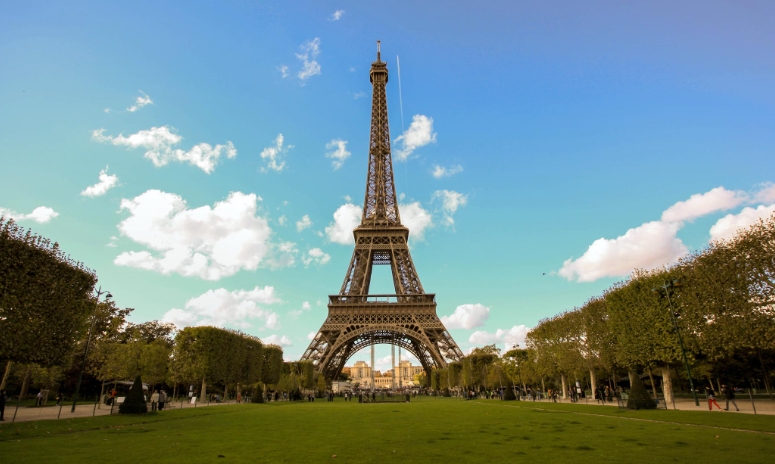
Sitting on the grass at Champ de Mars and watching the tower light up
does not make your Paris trip any less complete.
Should You Eat at the Eiffel Tower?
Short answer:
Worth it for the experience, not for the food alone.
Tower restaurants are about atmosphere and occasion.
If budget matters, you’ll eat better elsewhere in the city.
One Last Thing Most Guides Won’t Tell You
Whether the Eiffel Tower feels magical
has little to do with whether you “went all the way up.”
It depends on this:
Were you in a moment where you could slow down?
If you’re rushed, tired, or already overwhelmed,
it becomes just another crowded attraction.
But if you give it the right moment—
sitting on the grass, watching the lights come on one by one—
you may suddenly realize:
Paris doesn’t become romantic all at once.
It happens slowly.